NEW TECHNOLOGY IN THE BATTLEFIELD

This article was originally published in Viestimies-journal in Finnish. This is translation to English with some minor changes.
The pictures are from the RAND publication Distributed Kill Chains.
Leveraging New Technology In The Battlefield
Technological development is visible on the todays battlefield. Increased sensors enable new ways of gathering information; drones have brought a new dimension to conflicts such as the war in Ukraine, and unmanned and loitering systems are already a reality today.
In terms of information technology, the technological development trajectory can be divided into two parts. The development of data networks and telecommunications brings new dimensions to communication between both people and machines. Previously, communication links between service branches enabled joint operations, whereas today we can leverage information shared by an individual citizen's device or even surveillance cameras.
Software-based systems enable autonomous and, to some extent, even "thinking" systems. As an example, current technology enables loitering drones equipped with a camera and an explosive. The drone can be parked in a suitable location and programmed to detonate when the camera identifies a target. The technology exists and is implementable. Its use is limited more by ethical principles and legislation than by the actual capability implementation.
But what does full exploitation of networking and software-based systems ultimately require?
The Evolution of Digitalization in Warfare
Digitalization has enabled warfare to change to such an extent that we might even speak of paradigm shifts. One architectural vision currently under discussion is Mosaic Warfare. DARPA has published extensive material on it, and organizations such as CSBA and RAND Corporation have analyzed the topic in detail. In their publication "Distributed Kill Chains," RAND presents an evolutionary path that has led to the emergence of the Mosaic Warfare concept.
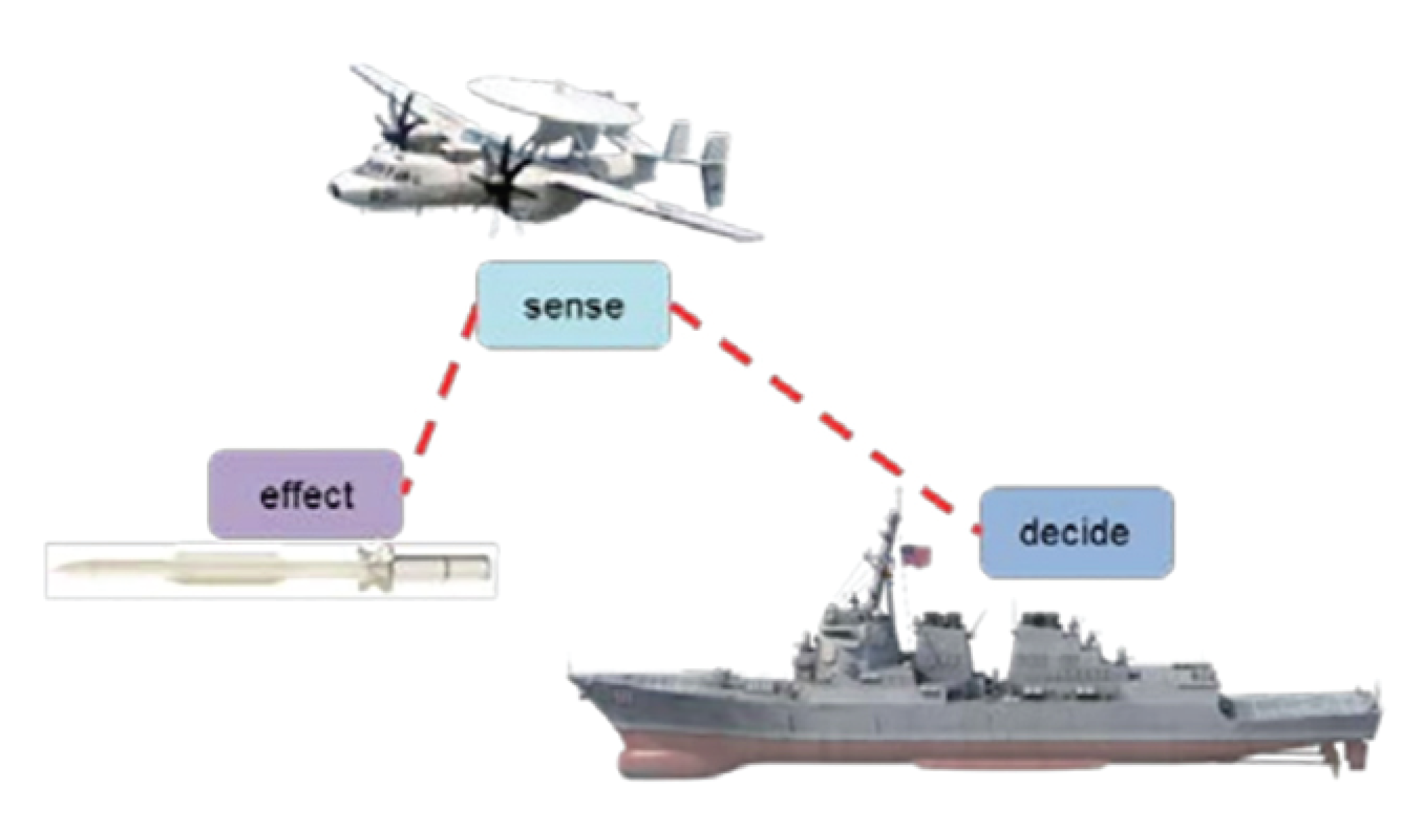
Distributed killchain is a well-known concept. The kill chain includes stages such as F2T2EA: Find, Fix, Track, Target, Engage, and Assess, or sometimes the 5Fs abbreviation is used (Find, Fix, Fire, Finish, Feedback). Distribution refers to dividing the stages among different actors.
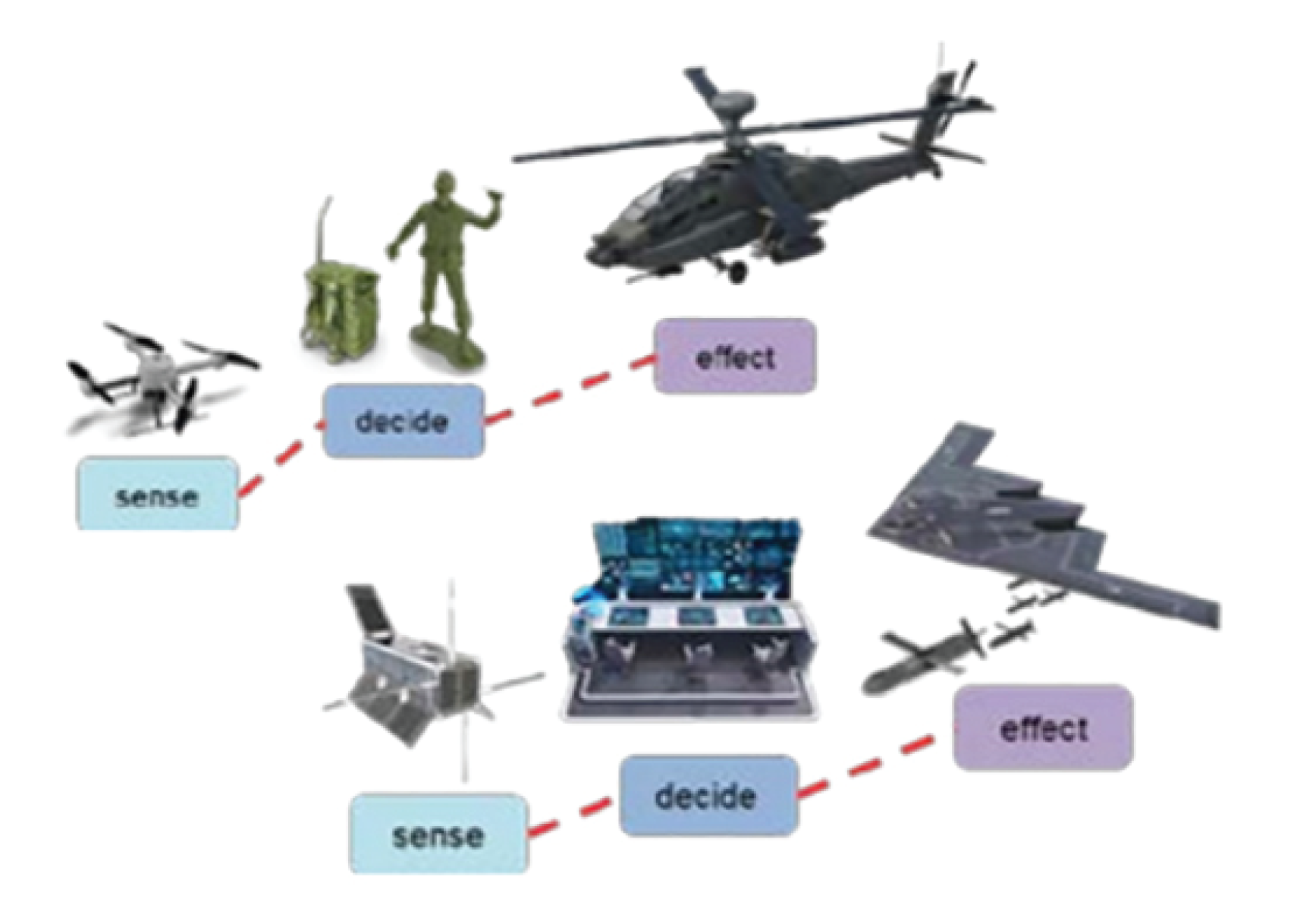
System of systems is an architecture where multiple kill chains are created through integrations between systems. This model seeks greater effectiveness through cooperation between systems than individual systems would have separately. The model is functional as such, but integrations are always expensive and slow to implement. What's essential is that integrations are at the system level, and thus the system's performance is used through an interface. This interface is usually limited in terms of what capabilities it offers for external use. The whole consists of static system-level integrations and doesn't adapt very well to the situation. Operational planning must take into account which integrations can be utilized, and one cannot start from the premise that planning is done freely and the system bends to one's will.
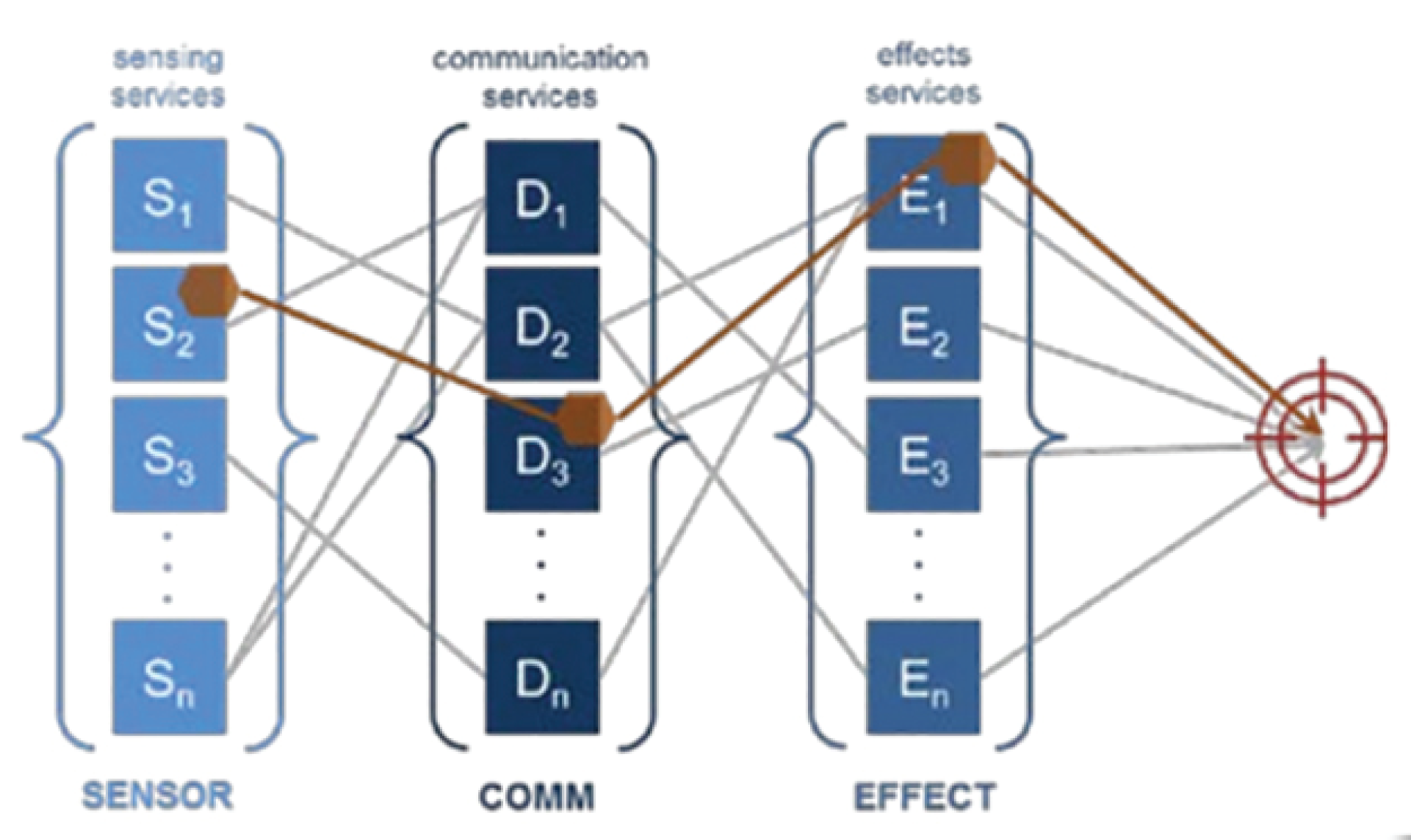
Adaptive killweb takes integrations to a new level. The assumption is already that all integrations exist and are available, and above all, the concept of "system" becomes more fine-grained. Operational planning can be done freely, choosing which different kill chains to utilize, but the choice must be locked in temporally – the operation's mode of action is chosen and that's what is followed.
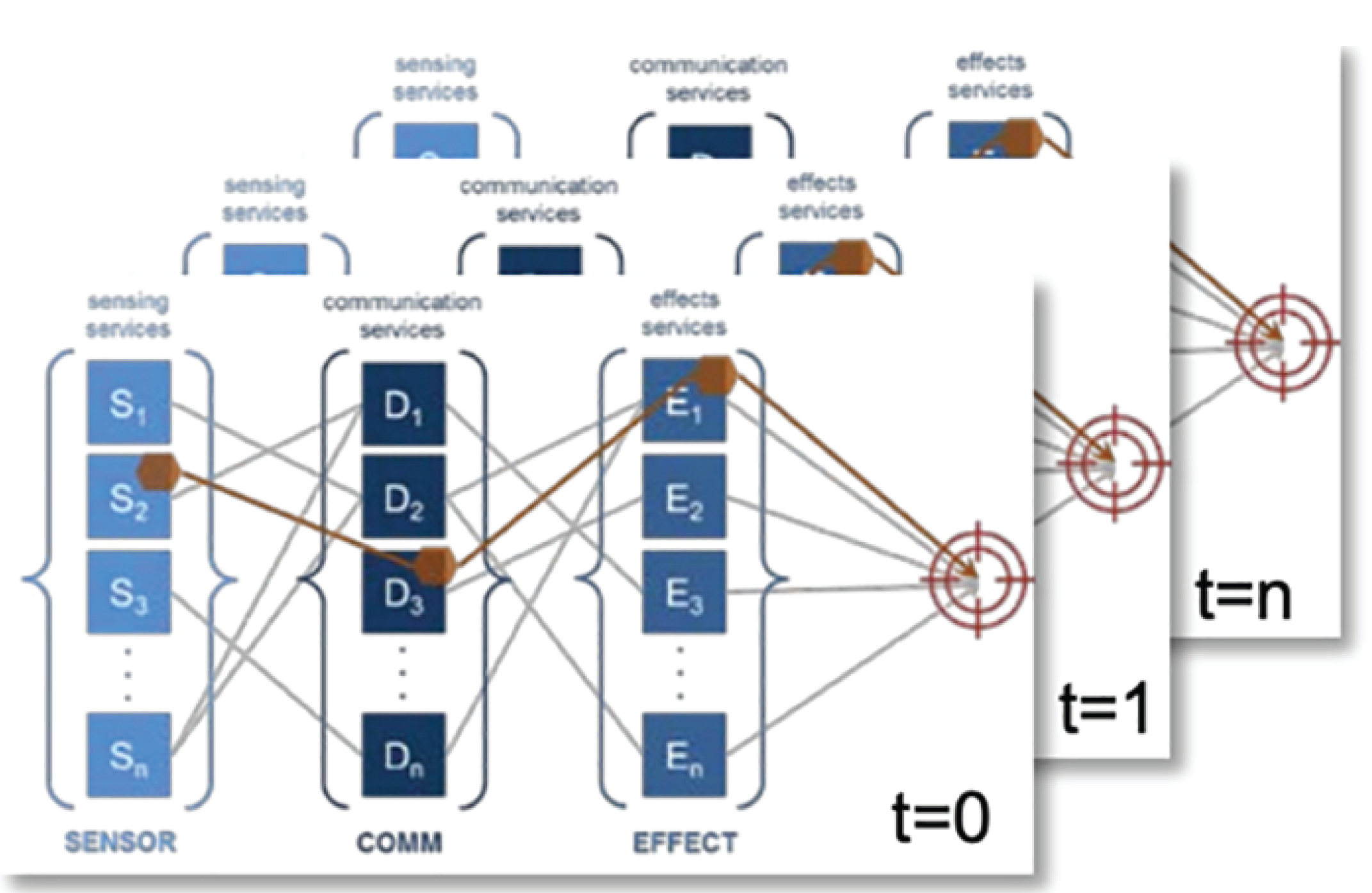
Mosaic warfare takes the thinking even further. Instead of choosing in advance during operational planning what kind of effects and thereby kill chains to utilize at which moments, fundamentally everything can be utilized at all times. The whole adapts to the situation during the operation and enables, for example, automatic integration between systems and technically even automatic engagement. Integrations are at a very granular level, and for instance, cues can be requested from a satellite when certain conditions are met, and actions taken accordingly. The concept of kill chain becomes blurred and becomes more one of the chosen ways of engaging rather than a single pre-identified way to engage.
Interestingly, in the last two scenarios, the "decision" phase has been omitted. The whole is integrated to such an extent that it can be thought of as a war machine configured to operate either in the distributed killweb scenario in advance or in the mosaic warfare scenario automatically and completely dynamically during the operation.
The Significance of Digital Development Steps
When considering the harsh reality, it doesn't matter which of the mentioned development stages one is at. One can bluntly and coldly cynically state that, for example, Mosaic Warfare is a vision and ideal that no country will achieve. The same applies to distributed killweb and even system of systems. Such ideals are necessary to guide development and to create people's understanding of what could be possible and what they should be able to demand. All this is of course necessary from the perspective of managing technological development, but temporally it's more about developing readiness rather than the moment when operations are being planned.
But what does matter when push comes to shove?
If we consider the whole, it's important in warfare to maintain tempo and act flexibly. The goal is to put the adversary in a reactive state and thereby achieve the role of the initiator in battle. This requires very good intelligence gathering and especially the ability to utilize what has been gathered. It requires good cooperation and adapting one's own actions to the adversary's actions.
In particular, it also requires the ability for creativity under severe pressure and the capability to rapidly utilize new technology in new ways. If and when technological development steps are achieved, one's own operations must be able to adapt to new possibilities quickly. This is not about carrying new apparatus to the battlefield; anyone can do that. The differentiating factor is the speed of creating the capability to utilize it in operations.
The Ability to Adapt and Adopt
Traditionally, the defense industry has its own heavy and lengthy procurement processes. Equipment acquisitions are indeed massive projects where, among other things, one must be certain that the equipment is suitable for defined conditions. One must ensure that maintenance and supply security work even in exceptional circumstances. Additionally, training organizations must at least be updated or even recreated to match new equipment. These are processes that can take years.
Currently, the adoption of new technology follows a similar productization pipeline as other combat materiel. From idea to prototype takes its own time. Productization takes its own time, after which the whole is tested, and testing alone easily operates on a one- or two-year time cycle. This often stems from accustomed procurement methods.
However, regarding new technology, one must be able to respond to the cadence of technology field's development quickly when necessary. A year of testing for a software release or even a loitering drone is too much. There must be the capability to utilize and test technology in real operations almost immediately, so as not to lose the advantage gained from technological development and research work. New quantum technology that breaks enemy encryption doesn't help anyone if it takes two years to reach the front.
In industry, high cadence is everyday life. For example, already in 2015, Amazon made 50 million updates to its online store. That means a new update more often than every second. This is a huge contrast to a years-long productization pipeline. High update frequency enables controlled testing in production, which offers a tremendous advantage over competitors who test features in large batches once a year.
In normal times, development proceeds at its own, somewhat leisurely pace. But when things get tough, the capability to rapidly utilize new capabilities isn't built in a moment. It's a slow process. It requires suitable infrastructure, the right expertise, and also culture. These must be ready already in peacetime, even if there isn't a need to utilize them then.
Conclusion
Networking and software-based systems today bring even unexpected opportunities, but to exploit them, an organization must have the basic capability for rapid adoption of new things. What's important is not achieving a grand vision like Mosaic Warfare but the capability to implement and adopt new technology. Without it, there's a great risk that the initiative will be taken by a more adaptable party.
Even in a new world, basic operations carry the day, and refining them creates the ability to leverage new things.